
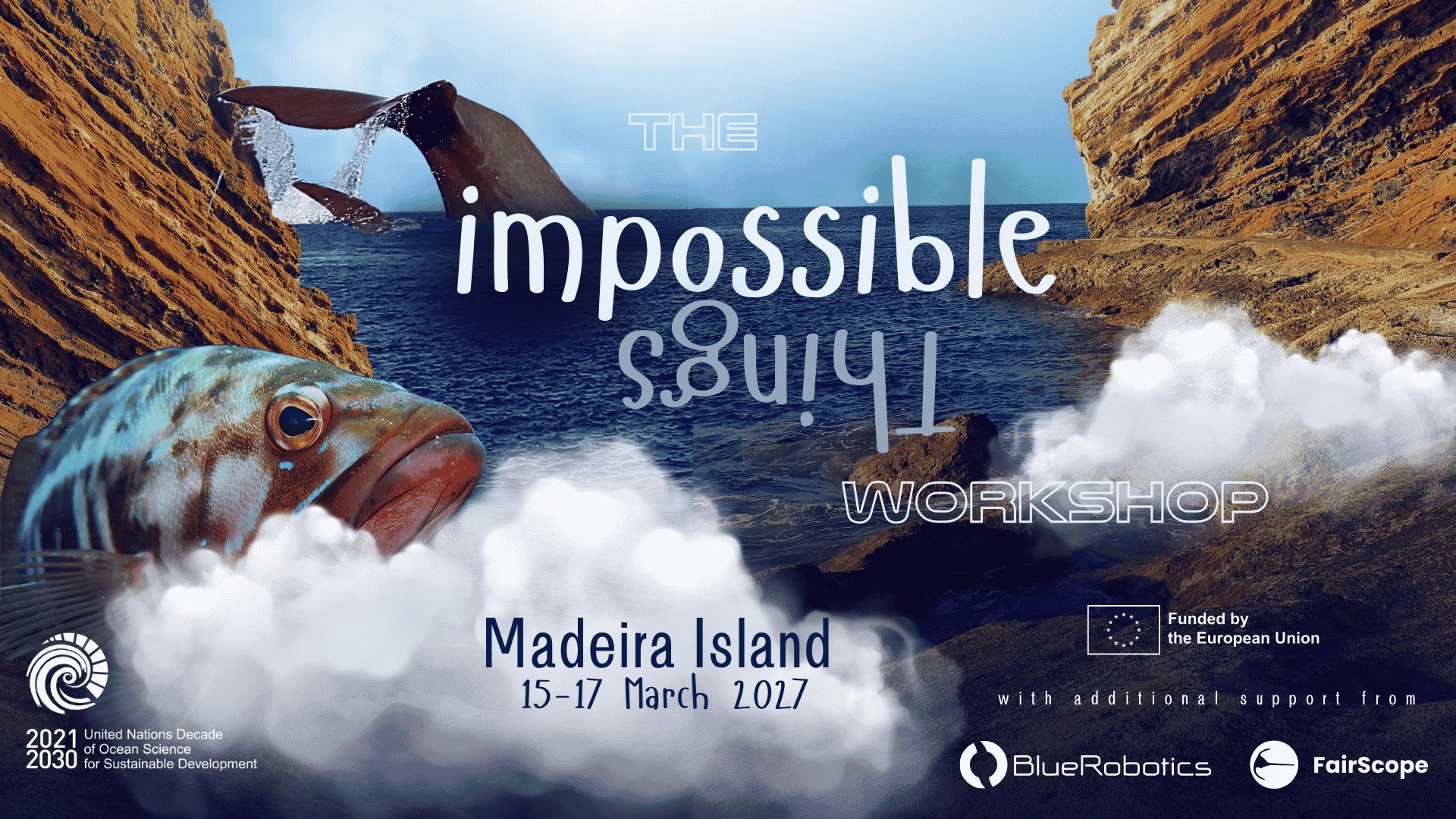
Original photo credits: Susanne Schäfer and Ana Dinis
It’s been actively researched since 1872, and yet the deep-sea remains 95% unexplored, 75% unmapped and with 70% of its species unknown.
Small institutes, especially on islands with easy access to the deep sea, could play a major role in accelerating our understanding of the deep sea. However, major barriers to research stand in our way — usually expense, manpower or skills, and sometimes technological or data challenges that even the best deep-sea research institutes face.
The Impossible Things Workshop seeks to bring creative thinkers from beyond deep-sea research to help us explore solutions to these challenges. With your help, perhaps the deep sea can become just that little bit more accessible.
^ watch our recap video produced by Patrícia Nunes (MARE-Madeira)
Now accepting applications to participate in our next Impossible Things Workshop! Applications close 1 Dec 2026
Our 2027 Impossible Challenges
Counting Carbon
Low-cost carbon monitoring
The ocean absorbs an estimated 30% of human-driven CO2 emissions, with rising levels causing ocean acidification and impacting marine life. Due to the complexities and expense of monitoring carbon, large gaps remain in understanding how ocean carbon is distributed and changing. This challenge will brainstorm new, low-cost approaches to monitor organic and inorganic carbon. We’ll draw on chemistry, novel sensors and frugal science efforts to draft possible systems for low-cost, scalable ways to track carbon around the world and throughout the water column.
Protecting Our Protections
Improving the management and monitoring of MPAs
Marine protected areas (MPAs) safeguard habitats and species from destructive human activities, replenish fish stocks and build resilience to climate change, but their effectiveness varies greatly by region. Implementation faces challenges of local resourcing, public awareness and technological limitations. How can we improve infrastructure to enable global MPA implementation while promoting healthy relationships among coastal communities? We’ll brainstorm new tools (or combinations of existing tools) to aid law enforcement, community engagement ideas and pilot studies for a realtime MPA monitoring network.
Big Datasets, Bigger Challenges
Developing tools for accessible, ethical and sustainable data sharing
Today, ocean research is swimming in acoustic, visual, bathymetric and other survey data, but only a fraction is easily accessible to all. Creating shared databases for large datasets is a huge challenge in ocean research. How do we ensure consistent metadata, incentivise contributions, acknowledge data providers, govern access responsibly and even decide where and how all this data should be stored? We need your help to brainstorm the tools, frameworks and ethical considerations needed to build trusted data-sharing platforms.
Magnifying the Microscopic
Low-cost zooplankton monitoring
Zooplankton play a critical role in marine food webs and ocean carbon cycling, yet monitoring zooplankton still relies heavily on nets and costly equipment. We need new ways to observe these tiny organisms directly in their natural environment and track how their abundance and diversity change over time. In this challenge, we’ll work together to design innovative, low-cost systems capable of detecting, imaging, retrieving and/or classifying zooplankton in the deep sea.
Highlights from 2025


This workshop, like all TWILIGHTED activities, is funded by the European Union. We are also grateful for the additional support provided by