Photo credits: Beatriz Arraiol (ARDITI)
Be our guest!
Lessons from our expert visits so far
By Diane Esson
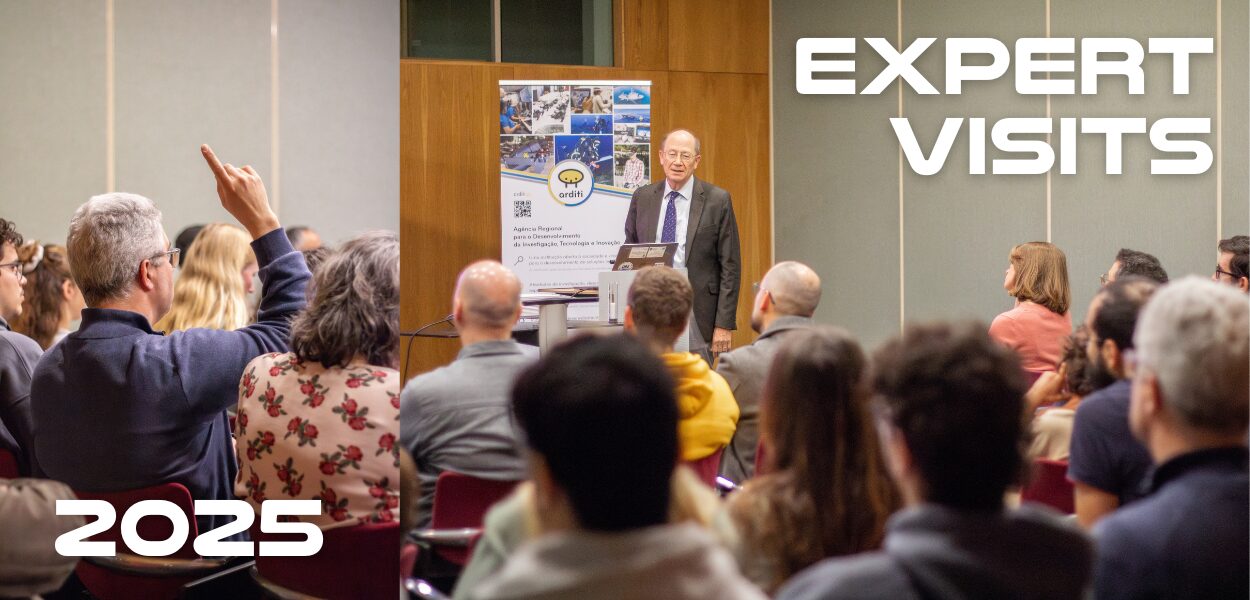
Over the course of 2025, we welcomed three experts to MARE-Madeira (ARDITI) to share their insights into deep-sea research and communication, helping to expand local knowledge and community engagement in deep-sea science in Madeira, Portugal. These visits provided MARE-Madeira researchers with unstructured time to ask specific questions related to deep-sea research techniques, career development questions and other advice. This year, our experts covered underwater cabled observatories for long-term monitoring, acoustic monitoring and ocean education.
March: Prof Bruce Howe
Underwater cabled observatories
We had the privilege of welcoming Prof Bruce Howe to MARE-Madeira (ARDITI)’s facilities in March, where he gave a talk on SMART Subsea Cables. Prof Howe, from the University of Hawaii at Manoa, is Chair of the UN’s Joint Task Force for SMART Subsea Cables, a Fulbright scholar and took part in TWILIGHTED’s Impossible Things Workshop prior to his seminar.
Prof Howe highlighted Portugal as one of the countries leading the way in its SMART cable plans for a new network connecting Madeira, the Azores and mainland Portugal in 2026. He also highlighted the opportunity to make good use of the old cables, which can be used to power deep-sea observatories in Madeira.
For long-term monitoring in Madeira, cabled observatories offer relatively low-cost (with limited environmental data) and high-cost (with high-value ecological data) options implementable within a year. Both options could deploy cables down Madeira’s steep slopes to around 500-600m, with sensors (low-cost) or other monitoring devices (higher cost) attached incrementally along the cable to gather data at discrete depths.
Lower cost option:
- Deploy thin fiber optic cables (not strongly armored) with basic environmental sensors at nodes along the cable.
- Data: Environmental data (oxygen, salinity, temperature) and hydroacoustics transmitted via the fiber-optic cable. These sensors are low energy-intensive.
- <€100,000 full set-up, similar to a system already in Bermuda. Cable costs around €5,000 (€5/meter and with 1,000m of cable, can reach around 500-600m in depth off Madeira’s coast).
Higher cost option:
- When new subsea cables are laid in Madeira (2026), the cable-laying ship can also bring up the old cables and allow the installation of an observatory and SMART nodes (to attach sensors and other equipment such as cameras, lights or hydrophones) on the cable.
- A similar set-up already exists in Hawaii (Station Aloha) and Norway.
- Cost: millions for installation and maintenance, but these systems can last for up to 20 years. Furthermore, each node can receive 10 kW of power, for example – compare to other deep-sea monitoring systems where supplying 1W for a year of monitoring is a major challenge.
Prof Howe offered valuable insights into the value of SMART cables for science, commerce and public safety and his seminar provided an opportunity to build the foundation for such a program in Madeira.
SMART Cables website: https://www.smartcables.org/
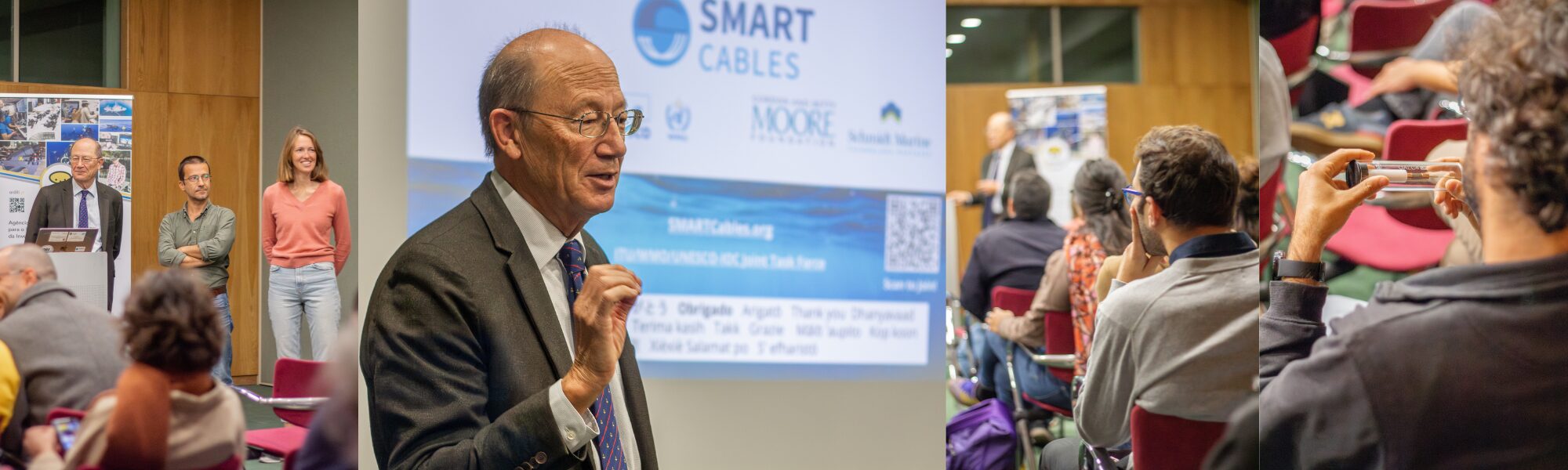
Prof. Bruce Howe with TWILIGHTED coordinator João Canning-Clode and science manager Diane Esson; Prof Howe presenting on SMART cables and passing a segment of cable around the room. Photo credits: Beatriz Arraiol (ARDITI)
October: Prof. Michel André
Acoustic monitoring
Michel André is a professor at the Technical University of Catalonia (UPC), Barcelona, Spain where he is the Director of the Laboratory of Applied Bioacoustics (LAB). Prof André’s research involves the development of acoustic technologies for the control of noise pollution in the marine environment; the study of the biological and pathological impact of noise pollution on marine organisms acoustic pathways; and the mathematical, physical, morpho- and electro-fisiological mechanisms of the cetacean bio-sonar as well as the extraction of the information from their acoustic signals.
Michel André led a roundtable discussion with six members of the MARE-Madeira (ARDITI) team to discuss acoustics hardware, deployment and data analysis challenges, as well as share current low-cost innovations and techniques used in Madeira to get Prof André’s perspective. This conversation paved the way for further collaboration and will be followed up with staff exchanges to Prof André’s LAB in Barcelona – starting with the opportunity to assist in species identification from long-term recordings in Madeira using the identifier that André’s lab built.
Some learnings from the conversation:
- Low-cost hydrophones are generally okay for detecting the presence or absence of some fishes. But if you want a soundscape, you need calibration. In the deep-sea, it’s also important to remember that as temperatures change, the soundscape will change as well.
- Prof André admitted that in the past, he concentrated on species identification without considering that those sounds were made in an ecosystem. As a result, his dataset is missing a lot of important information about ecosystem interactions. He encouraged us to include all the ecosystem sounds, even when recording for species identification, so we can have a fuller picture of the environment when those sounds are happening.
- We also talked about the possibility of a permanent station that sends data to the surface (e.g. a buoy). However, this data needs to be processed, as it’s too heavy to send raw data.
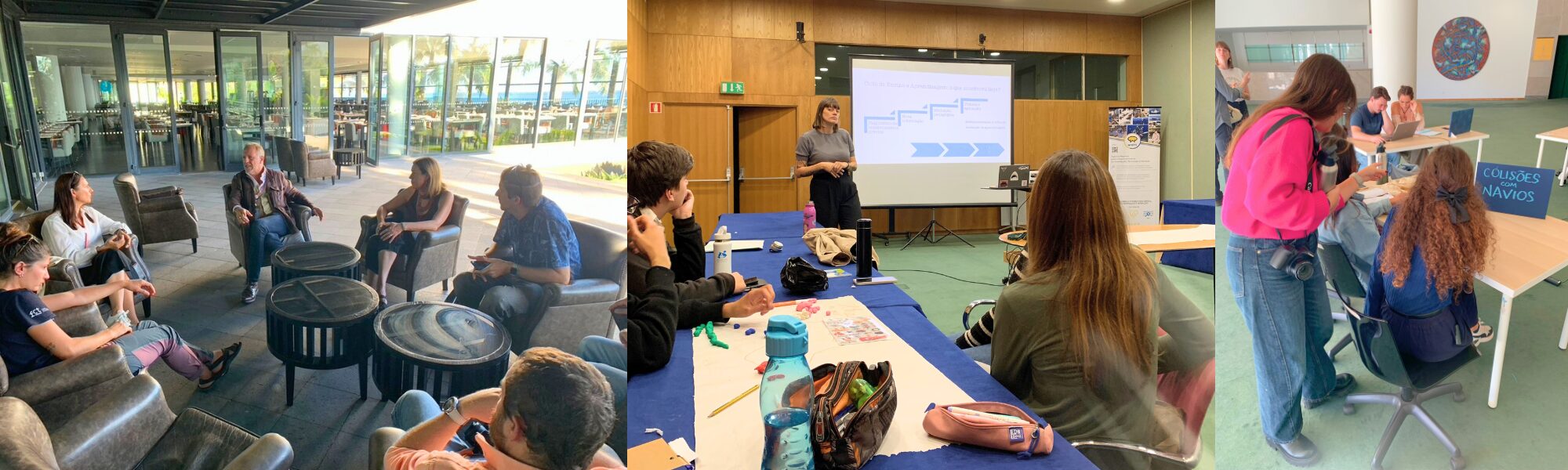
Prof André discussing acoustic monitoring with MARE-Madeira and Yolanda Sánchez leading her educational activity at a workshop at MARE-Madeira (ARDITI). Photo credits: Diane Esson
December: Yolanda Sánchez
Ocean education
Yolanda Sánchez is co-founder of the Latin American Marine Educators Network, Fund Engagement Manager for OCEAN Grants Programme, writer of illustrated nature books, and a member of the Edinburgh University Ocean Leaders Programme. With extensive experience across universities, NGOs, governments, and local communities, Yolanda has been involved in projects in Latin America, Africa and Europe to enhance educational methodologies and design marine education initiatives that prioritise ocean connections and community empowerment.
Yolanda Sánchez visited MARE-Madeira (ARDITI) as a mentor in the Blue Stories Workshop in December 2025. TWILIGHTED members and MARE-Madeira communication team members Diane Esson and Patrícia Nunes, as well as ARDITI communication team members Sara Bettencourt and Beatriz Arraiol were able to learn from Yolanda’s ocean education and outreach approach both before and during Yolanda’s visit.
Through one-to-one calls in the months leading up to the workshop, Diane and Patrícia were witness to the design of Yolanda’s ocean literacy workshop activity, seeing how she integrated locally-relevant marine science topics to create a tailored educational activity for workshop participants on non-indigenous species. During Yolanda’s visit to Madeira, MARE-Madeira and ARDITI team members were able to observe how Yolanda applied her educational framework:
- Understand previous knowledge
- Incorporate new information
- Educational meditation
- Practical application
Following this method, Yolanda invited workshop participants to first share their current understanding of non-indigenous species in Madeira and reflect on how these species might impact the island. Then she introduced a game and set some basic rules for participants to follow (e.g. on how many native and non-native species each team could have and how much food was available to each species). Through the course of the game, Yolanda invited participants to invent new rules that would allow them to manage their non-native species’ growth. Through this technique, participants were able to ‘see’ the effects of non-native species on local ecosystems and attempt to manage them – giving a hands-on educational experience into this real-life issue in Madeira. Following the game, Yolanda asked participants to create fake social media posts ‘to educate your communities’ about their invented non-native species. Finally, she shared new, real information about specific invasive species in Madeira, their possible impacts and the research being done to understand them better.
The structure that Yolanda introduced offered a fresh perspective on creating engaging activities for sharing ocean science. Specifically, Yolanda’s framework ensures that learning is not unidirectional, but a sharing of ideas before, during and after an activity. She recommends key concepts be discovered (e.g. through playing a game) rather than taught. We hope to incorporate these learnings into new educational activities for TWILIGHTED and beyond at MARE-Madeira / ARDITI.